

The Interview - M.L. Woodward: Real History, Hidden Mysteries and the Adventures of Tianna Howard
https://tiannahowardadventures.com


What inspired you to start writing the Tianna Howard Adventures?
The original inspiration was my youngest daughter. Like Tianna, she's of mixed heritage, and I wanted her to have a heroine she could identify with. Someone who looked a bit like her, who was intelligent, adventurous and capable of standing up for herself. I wanted her to see someone like herself at the centre of the story, rather than always being a supporting character.
I've lived in Asia for much of my adult life and travelled extensively, so I started thinking about the places I'd visited and the extraordinary history behind them. I've always been fascinated by unsolved mysteries, particularly those involving lost treasures and historical puzzles.
It seemed like a good way to bring everything together. I could give my daughter a character she might recognise herself in, while taking readers on adventures through real places and genuine historical mysteries.
I suppose the books started with something quite personal, and then grew into something much bigger.
Why did you choose real historical mysteries rather than fantasy?
There's nothing wrong with fantasy, of course, but I've always been more interested in the mysteries that actually exist.
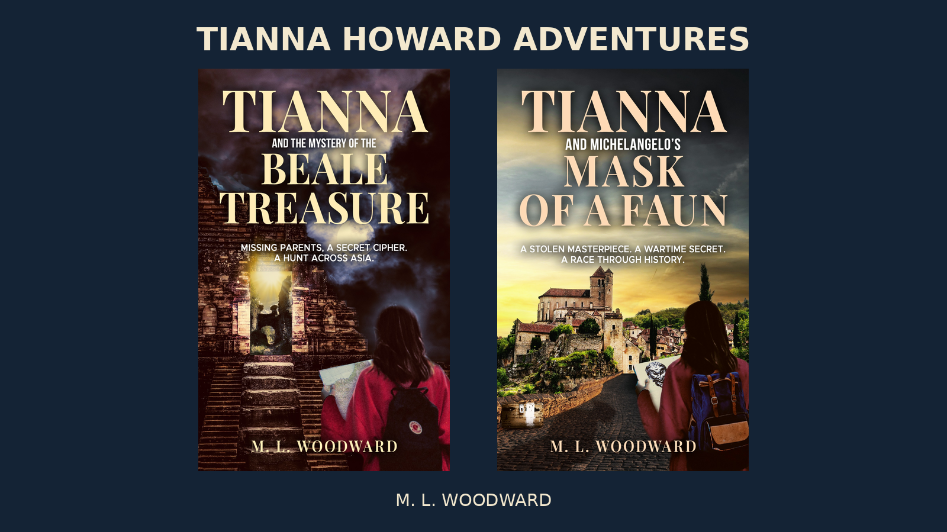
The Beale Treasure, for example, is a genuine unsolved mystery involving coded messages and a supposedly buried fortune. Michelangelo really did carve a sculpture known as the Mask of a Faun when he was young, taken by German soldiers during WWII.
I find that fascinating. We have all these extraordinary stories from history, many of which remain unresolved, and they're sitting there waiting to be explored.
I wanted readers to finish one of my books and perhaps look something up, discover that a place or historical event was real, and become curious enough to learn more.
How have your travels influenced the books?
Quite a lot, actually. I've lived in Asia for many years and travelled extensively, so when I started writing the first book, I naturally drew on places I knew. I've run an ultramarathon at Angkor Wat, spent time in Bali, travelled through China extensively, and visited all of the locations that appear in The Beale Treasure.
For the second book, Michelangelo's Mask of a Faun, I drew on another running trip through Italy and my interest in the art and history of Florence.
I think having been somewhere makes a difference when you're writing about it. You remember little things that don't necessarily appear in guidebooks. The atmosphere, the streets, the sounds, smell, and the chaos of getting around.
Of course, I still do plenty of research. Being somewhere doesn't automatically make you an expert on its history!
Tell us about Tianna Howard. What makes her an interesting character to write?
Tianna is bright, inquisitive and quite stubborn. She's also young enough to make mistakes, which is important, because I didn't want to create a character who always gets the answer right or somehow manages to outsmart every adult she meets.
She's growing up between different cultures, something I understand from my own family, and she's trying to work out who she is while finding herself caught up in situations that most adults would struggle to handle. Her grandfather, Professor Charles Howard, is an Oxford art historian, so she has access to a great deal of knowledge. But knowing something about history and dealing with dangerous people are two very different things.
I enjoy writing the relationship between Tianna and her grandfather. They don't always agree, and she certainly doesn't always listen to him, but there's a great deal of affection between them which grows over the books.
How much research goes into writing a Tianna Howard adventure?
Lots more than I originally expected! Because the books are grounded in real history, I have to be careful about separating historical fact from the fictional story I've built around it.
For Michelangelo's Mask of a Faun, I spent a lot of time researching Renaissance Florence, the young Michelangelo and the Nazi theft of European art during the Second World War. That led me to the Monuments Men, Rose Valland and the extraordinary efforts made to recover stolen artworks, so much so that I've built a youtube channel around it. The research often takes me in directions I hadn't anticipated. I'll come across a small historical detail that suddenly gives me an idea for an entire chapter, for example, Trent Park, absolutely fascinating and integral to the war effort, and I'd not heard of it before.
I would highly recommend readers go to the YouTube channel where they can explore some of the real history behind the adventures. I thought it would be interesting for them to discover which parts of the stories actually happened.
What has been the biggest challenge in becoming an independent author?
I think the biggest surprise has been discovering just how much work begins after you've finished writing the book. When I started, I was concentrating on the story, the characters and the countless rewrites, to just get the manuscript into shape. I hadn't really appreciated how much there was to learn about editing, formatting, hiring cover artists, publishing and, of course, marketing. Writing a book is one thing. Persuading someone who has never heard of you to give it a chance is quite another.
I've made a lot of mistakes along the way, and I'm still learning. But I've also found the whole process fascinating. There's something rather satisfying about holding a printed copy of a book that started as an idea in your head.
What do you hope young readers take away from your books?
First and foremost, I hope they enjoy the adventures. I don't want anyone to feel they're being given a history lesson disguised as a novel, but if a reader finishes a book and wants to know more about Angkor Wat, Michelangelo, the Inca Empire or one of the other historical subjects I've written about, then I'll be delighted.
There's an enormous world out there, full of remarkable places, people and stories. You don't need magic to make it interesting.
I'd also like readers to see that curiosity, determination and a willingness to question things can take you a long way. Tianna certainly gets herself into trouble by asking questions, but that's all part of growing up.
What's next for Tianna Howard, and what are you working on now?
I'm currently working on the third adventure, Tianna and the Lost Inca Gold, which takes Tianna to South America and into the mysteries surrounding the Spanish conquest of the Inca Empire. It's a fascinating period of history, with extraordinary characters such as Francisco Pizarro and Atahualpa, all wrapped up in a classic treasure hunt.
I've also been developing another adventure involving the disappearance of the Irish Crown Jewels in 1907, which is a real mystery that has never been conclusively solved and has many famous characters involved, such as Sir Arthur Conan Doyle and Francis Shackleton. I'm still chewing this one over but I'm looking forward to starting it properly. Again, I did a running trip in Ireland last year and I absolutely loved Dublin.