

#LiteraryAnalysis
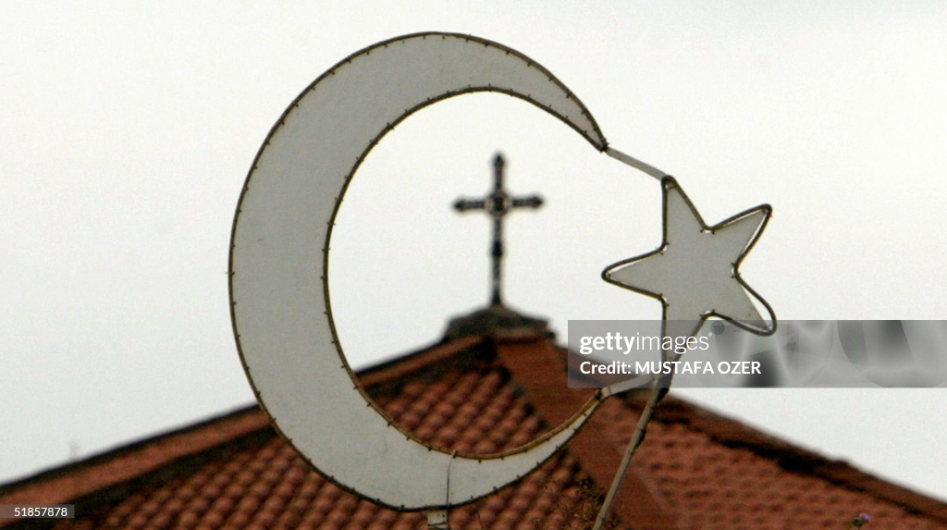
Islamic Assault ‘n Christian Retreat
In what could probably be the most ironical ‘irony of silence’, the mighty Western world, in the face of the Quranic assault against its Christian faith in the mosques, madrasas and mohallahs that too on its own soil, had come to adopt the mute mode! Not only that, the redoubtable Pope of the day, in the Supreme seat of the Catholic power, whose predecessors ushered in the crusades against Mohammedans to recover their Holy Lands in Middle East, remains a mute spectator even as Islamist immigrants have been aggressively asserting their faith all over Europe these days.
Just for the uninitiated, here are a few samples of the Quranic assaults against the Christians, and Jews as well, from Muhammad Marmaduke Pickthall’s The Meaning of the Glorious Quran.
“They indeed have disbelieved who say: Lo! Allah is the Messiah, son of Mary. Say: Who then can do aught against Allah, if He had willed to destroy the Messiah son of Mary, and his mother and everyone on earth? Allah’s is the Sovereignty of the heavens and the earth and all that is between them. He createth what He will. And Allah is Able to do all things.”
“They surely disbelieve who say: Lo! Allah is the third of three; when there is no God save the One God. If they desist not from so saying a painful doom will fall on those of them who disbelieve.”
“O ye who believe! Take not the Jews and Christians for friends. They are friends one to another. He among you who taketh them for friends is (one) of them. Lo! Allah guideth not wrongdoing folk.”
“They long that ye should disbelieve even as they disbelieve, that ye may be upon a level (with them). So choose not friends from them till they forsake their homes in the way of Allah; if they turn back (to enmity) then take them and kill them wherever ye find them, and choose no friend nor helper from among them.”
And ominously, “All they who disbelieve and deny our revelations, such are rightful owners of hell.”
“We shall cast terror into the hearts of those who disbelieve because they ascribe unto Allah partners, for which no warrant hath been revealed. Their habitation is the Fire, and hapless the abode of the wrong-doers.”
Besides, Jehovah, in His Islamic avatar as Allah, was no kinder either to the Jews, His Chosen People:
“The likeness of those who are entrusted with the Law of Moses, yet apply it not, is as the likeness of the ass carrying books. Wretched is the likeness of folk who deny the revelations of Allah. And Allah guideth not wrong doing folk.”
“Say (O Muhammad): O ye who are Jews! If ye claim that ye are favoured of Allah apart from (all) mankind, then long for death if ye are truthful.”
“But they will never long for it because of all that their own hands have sent before, and Allah is Aware of evil-doers.”
“Say (unto them, O Muhammad): Lo! the death from which ye shrink will surely meet you, and afterward ye will be returned unto the Knower of the invisible and the visible, and He will tell you what ye used to do.”
However, it is another matter that having all along castigated the Christians for having made Jesus and Mary partners to Allah, Muhammad, in Quran’s ninth sura that proclaims the immunity from obligation towards the idolaters, had himself partnered Allah by way of “Freedom from obligation (is proclaimed) from Allah and His messenger toward those of the idolaters with whom ye made a treaty”! Surely, power corrupts and absolute power corrupts absolutely.
Be that as it may, the evangelists, who lay great store on the Christian path of salvation and prowl all over the planet earth to snare the so-called heathens into the fold of Jesus, fail on their very own Christian turf to silence the mullahs and maulvis, who ridicule their faith. Though this may appear strange, actually it is easy to comprehend for wittingly or unwittingly, Muhammad, with the following Quranic links, had ensured that any criticism of Islam by the Jews and the Christians would undermine their own faith thus:
“Lo! We did reveal The Torah, wherein is guidance and a light, by which the Prophets who surrendered (unto Allah) judged the Jews, and the rabbis and the priests (judged) by such of Allah’s Scripture as they were bidden to observe, and thereunto were they witnesses. So fear not mankind, but fear Me. And barter not My revelations for a little gain. Whoso judgeth not by that which Allah hath revealed: such are disbelievers.”
“And We caused Jesus, son of Mary, to follow in their footsteps, confirming that which was (revealed) before him, and We bestowed on him the Gospel wherein is guidance and a light, confirming that which was (revealed) before it in the Torah – a guidance and an admonition unto those who ward off (evil).”
“Say: O People of the Scripture! Ye have naught (of guidance) till ye observe the Torah and the Gospel and that which was revealed unto you from your Lord. That which is revealed unto thee (Muhammad) from thy Lord is certain to increase the contumacy and disbelief of many of them. But grieve not for the disbelieving folk.”
So, as disputing the Quran would tantamount to debunking the Torah and the Gospel, more so as the nature of their God is the same, as under, so to say, Muhammad’s one-upmanship had pushed his Semitic cousins and the Gentile converts into a catch-22 situation, much before Joseph Heller came up with it.
“And We prescribed for them therein: The life for the life, and the eye for the eye, and the nose for the nose, and the ear for the ear, and the tooth for the tooth, and for wounds retaliation. But whoso forgoeth it (in the way of charity) it shall be expiation for him. Whoso judgeth not by that which Allah hath revealed: such are wrong-doers.”
It’s thus a theological silence prevails in the evangelical world to its own detriment what with the Western Christians in numbers are embracing Islam that is regardless of its terror tag.
However, when it comes to Hindus, they suffer from the bliss of ignorance, for somehow (God knows how!) they have come to assume that the precepts of all religions could not be but noble, never mind the ignoble practices of some of their followers. But in effect, they, sans the Semitic exclusivist religious baggage, are the best placed to engage with Islam that has become a scourge of humanity by way of impressing upon the ummah that while the Mecca suras make Quran the noblest of scriptures, its egregious Medina suras, meant to serve Muhammad’s mundane mission, not Musalman’s spiritual needs, being period, should be treated as such.
[More on the Islamic ethos in Puppets of Faith: Theory of Communal Strife, a free ebook in the public domain, including this site- https://g.co/kgs/18bpdY]

THE PHILOSOPHY OF FYODOR DOSTOEVSKY - ALEXIS KARPOUZOS
Fyodor Dostoevsky’s literary corpus presents a fertile ground for interdisciplinary analysis, particularly at the intersection of existential philosophy and psychoanalysis. His novels grapple with profound questions of human nature, morality, freedom, guilt, and redemption, while simultaneously portraying intense psychological landscapes. This academic issue centers on examining the internal conflicts of Dostoevsky’s characters through the lenses of philosophical existentialism—particularly the thought of Søren Kierkegaard and Friedrich Nietzsche—and psychoanalytic theory, drawing from Sigmund Freud, Jacques Lacan, and Carl Jung. At the core of Dostoevsky’s narratives lies a tension between rationalism and irrationalism, faith and nihilism, individuality and collective identity. Characters such as Raskolnikov (Crime and Punishment), Ivan Karamazov (The Brothers Karamazov), and the Underground Man (Notes from Underground) serve as case studies for this examination. These figures embody psychological fragmentation and the struggle for meaning in a world perceived as morally ambiguous or even absurd.
The issue investigates how Dostoevsky anticipates psychoanalytic concepts such as the unconscious, repression, the death drive, and the divided self. It also explores how his theological and moral concerns engage with existential themes of despair, freedom, and authenticity. The analysis asks: How does Dostoevsky dramatize the philosophical problem of evil through psychological interiority? In what ways do his characters' inner conflicts reflect broader metaphysical anxieties about the human condition? By engaging with both philosophical discourse and psychoanalytic frameworks, this issue aims to contribute to a deeper understanding of Dostoevsky’s unique synthesis of narrative, psychology, and spiritual inquiry.
EXISTENTIAL DILEMMAS — FREEDOM, CHOICE, AND THE BURDEN OF SELFHOOD
Dostoevsky’s characters are essentially case studies in existential dilemmas, and he uses their inner turmoil to dramatize themes like freedom, moral responsibility, and the fragmented self. Here’s a breakdown of how these themes manifest in some of his key characters:
1. Freedom as Both Gift and Curse
Dostoevsky’s characters often confront absolute freedom—but rather than liberating them, it frequently becomes a source of anxiety, confusion, and moral crisis.
- The Underground Man (Notes from Underground) is perhaps the clearest example. He rebels against determinism and rational egoism, insisting that man will act irrationally just to prove he is free. He says, “What man wants is simply independent choice, whatever that independence may cost and wherever it may lead.” This paradox—freedom as self-sabotage—illustrates Dostoevsky’s challenge to Enlightenment rationalism and shows how unmoored freedom can become destructive.
- Raskolnikov (Crime and Punishment) uses freedom to test the Nietzschean idea of the “extraordinary man, ” believing he can transgress moral boundaries for a higher purpose. However, his intellectual freedom brings him unbearable psychological guilt. The burden of having to justify his freedom morally and spiritually becomes his torment.
2. The Anxiety of Choice and Moral Responsibility
Freedom, for Dostoevsky, is inseparable from choice, and every choice carries moral and existential weight. His characters are often paralyzed by the responsibility of choosing, especially in a world where moral foundations are unclear or contested.
- In The Brothers Karamazov, Ivan Karamazov intellectualizes the problem of evil and chooses to reject God’s world on moral grounds. But this “choice” becomes a torment, as his decision not to believe leaves him morally adrift. His nihilism is mirrored in the actions of Smerdyakov, showing that ideas and choices have real, often catastrophic consequences.
- Dmitri Karamazov also illustrates the anxiety of choice. His impulsive decisions reflect a man torn between sensual indulgence and spiritual longing. His choices are expressions of an uncentered self, deeply aware of his moral failures.
3. The Burden of Selfhood
Dostoevsky’s characters often struggle under the burden of self-consciousness, a theme he explores long before it became central to existentialist thought. His characters are not simply individuals—they are divided individuals, plagued by internal contradictions.
- The Underground Man again exemplifies this. He cannot act decisively because he is consumed by the need to understand and second-guess himself. His hyper-consciousness paralyzes him. “To be too aware is a sickness, ” he says—a core existential insight.
- In The Double, Golyadkin is literally confronted with another version of himself, dramatizing the inner fragmentation of identity. This prefigures what Sartre would later call “bad faith”—the inability to unify one’s self-concept under freedom.
- Stavrogin in Demons embodies the self completely detached from moral law. His philosophical detachment and emotional apathy turn freedom into a horrifying vacuum—a portrait of existential despair when freedom is stripped of all ethical or spiritual grounding.
QUILT, SUFFERING AND CONFESSION
Dostoevsky’s portrayal of guilt, suffering, and confession often prefigures psychoanalytic concepts, particularly those of Freud and Lacan, but he diverges in crucial ways—especially because he frames suffering not merely as a symptom of repression, but as a potential path to spiritual redemption. Let’s break this down by theme and theoretical lens.
1. Guilt: The Inner Tribunal
Freudian Alignment:
Freud viewed guilt as a product of the superego, the internalized authority figure that punishes the ego for transgressions—even imagined ones. In Crime and Punishment, Raskolnikov’s psychological breakdown exemplifies this idea. Even before he is caught, he experiences overwhelming guilt, hallucinations, and paranoia. His punishment begins long before the legal consequences, which mirrors Freud’s idea that guilt is internal, unconscious, and often irrational.
Freud also argued in Dostoevsky and Parricide that Dostoevsky’s obsession with father-figures and guilt reveals repressed Oedipal desires. For example, the parricide in The Brothers Karamazov becomes a literal enactment of Freud’s theory, with Ivan’s intellectual rebellion facilitating his father’s murder—a fantasy Freud believed Dostoevsky both indulged and punished himself for.
Lacanian Alignment:
Lacan would interpret guilt not merely as moral, but structural—arising from the subject’s alienation within language (the Symbolic order). Characters like Ivan Karamazov experience a guilt that isn’t just psychological but metaphysical: a guilt for existing in a broken moral universe, for being complicit in the world’s suffering. This aligns with Lacan’s idea that guilt can arise from being out of sync with the Name-of-the-Father (symbolic law).
2. Suffering: Neurosis or Redemption?
Freudian Divergence:
Freud saw suffering largely as a pathological symptom—something to be analyzed, explained, and ideally cured. In contrast, Dostoevsky treats suffering as a potentially redemptive force. For example:
- Raskolnikov’s path to moral and spiritual clarity is only possible through suffering.
- Sonya, his spiritual guide, accepts suffering not passively but with sacred dignity—transforming it into a moral act.
This Christian existential view diverges sharply from Freud’s secular, medicalized model of psychic suffering.
Lacanian Nuance:
Lacan’s notion of jouissance—the strange, self-destructive pleasure in pain or transgression—offers a closer match. Dostoevsky’s characters often cling to their suffering, even when it’s irrational or destructive (e.g., the Underground Man’s masochism). This aligns with Lacan’s idea that the subject is driven not by desire for happiness but by an enjoyment that exceeds the pleasure principle—something we see clearly in the perversity of Dostoevsky’s anti-heroes.
3. Confession: Talking Cure or Spiritual Catharsis?
Freudian Perspective:
Freud’s “talking cure” was based on the premise that bringing unconscious guilt into consciousness through verbal confession could alleviate neurotic symptoms. Dostoevsky uses confession—especially in Crime and Punishment—as a similar cathartic mechanism. Raskolnikov’s eventual confession is not only moral but deeply psychological, leading to the release of his internal torment.
Divergence:
However, Dostoevsky frames confession in spiritual terms. It is not just self-revelation but submission to divine grace. For Freud, confession clears repression; for Dostoevsky, it clears the soul. In The Brothers Karamazov, Alyosha’s idea of universal responsibility takes this even further—implying that confession is not just individual but communal and metaphysical.
Lacanian Take:
Lacan complicates confession by emphasizing that the subject is split and never fully knowable to itself. Confession, then, is not necessarily liberating—it may even reinforce alienation. Dostoevsky’s use of unreliable narrators (e.g., the Underground Man) and fractured interiority aligns with this. These characters confess compulsively, yet their speech often deepens their alienation, reflecting Lacan’s skepticism about the transparent subject.
CHRISTIAN EXISTENTIALISM AND THE NIHILISM OF NIETZSCHE
His Christian existentialism is in deep, often implicit, dialogue with the nihilism Nietzsche would later articulate. In fact, Nietzsche himself said, “Dostoevsky is the only psychologist from whom I have anything to learn.” Let’s break down the contrast through a few core themes that emerge in Dostoevsky’s philosophical dialogues:
1. Faith vs. Meaninglessness
Dostoevsky (Christian Existentialism):
Dostoevsky believes that in the absence of God, life loses all moral and metaphysical grounding. His characters often reach the brink of nihilistic despair, only to be offered (though not always accept) the possibility of salvation through faith, love, and humility. In The Brothers Karamazov, Alyosha represents this redemptive Christian existentialism—rooted in suffering, but ultimately affirming spiritual meaning.
Nietzsche (Nihilism):
Nietzsche, by contrast, sees the “death of God” not as a cause for despair, but as a challenge to create new values. He argues that traditional morality, rooted in Christian meekness and guilt, is a slave morality that denies life. Nietzsche embraces the abyss and urges us to become Übermenschen (overmen) who impose meaning on a godless universe.
Contrast: Where Dostoevsky sees the loss of God as a moral and existential catastrophe, Nietzsche sees it as an opportunity for liberation.
2. Freedom and Responsibility
Dostoevsky:
For Dostoevsky, freedom is unbearable without God. In The Grand Inquisitor, Ivan Karamazov’s parable criticizes Christ for giving humans the “burden of freedom.” He suggests that most people don’t want freedom; they want comfort, certainty, and authority. Dostoevsky’s Christian existentialism sees freedom as a gift only if it is grounded in love and spiritual truth.
Nietzsche:
Nietzsche’s freedom is radically autonomous. He calls for the revaluation of all values, even if it leads to existential vertigo. Freedom means taking full responsibility for the meaning you create—even if that leads to suffering or isolation.
Contrast: Dostoevsky sees freedom as dangerous without transcendence; Nietzsche sees transcendence as an illusion that limits freedom.
3. Suffering and Redemption
Dostoevsky:
Suffering is central to Dostoevsky’s theology. He believed that through suffering, one confronts the truth of the human condition—and potentially reaches redemption. Characters like Sonya, Prince Myshkin, and Alyosha demonstrate that compassion born from suffering can lead to grace and spiritual insight.
Nietzsche:
Nietzsche also values suffering—but as a test of strength. For him, suffering is not redemptive through divine grace, but transformative through personal will. He says, “What does not kill me makes me stronger.” His suffering is aesthetic, heroic, and life-affirming—not moral or redemptive.
Contrast: Dostoevsky’s suffering is redemptive in a Christ-like way; Nietzsche’s is existentially empowering, without moral judgment.
4. Dialogical Expression of These Ideas
Dostoevsky doesn’t write philosophy in treatises—he writes it through characters in dialogue and conflict.
- Ivan Karamazov is the closest Dostoevsky gets to a Nietzschean: an atheist, a rationalist, morally outraged at divine injustice. His “Rebellion” chapter could’ve come straight from Nietzsche—yet Ivan is tortured by his conclusions.
- The Grand Inquisitor, another of Ivan’s creations, argues that humanity cannot handle freedom and must be ruled by lies for their own good—a deeply Nietzschean, anti-Christian position.
- Alyosha, in contrast, lives out the possibility that faith, humility, and love are the only sustainable answers to the existential abyss.
Result: The tension in Dostoevsky’s work is not that Nietzschean nihilism is rejected outright—it is inhabited, explored, and found wanting.
DOSTOEVSKY’S TECHNIQUES OF DOUBLING AND NARRATIVE POLYPHONY
Dostoevsky’s techniques of doubling and narrative polyphony can be richly interpreted as a literary dramatization of the unconscious, long before Freud formally theorized it. These narrative strategies externalize the fragmented, conflicting aspects of the psyche, giving voice to the invisible tensions within a character’s inner world. Let’s unpack how this works:
1. Doubling: The Split Self and the Uncanny
Doubling in Dostoevsky often reveals a fractured self, dramatizing the division between conscious identity and repressed impulses—a literary equivalent of what Freud would later call the return of the repressed.
Key Example: The Double
- Golyadkin, the protagonist, is haunted by a doppelgänger who seems to embody all the social confidence and ambition he lacks. As the double grows stronger, Golyadkin unravels. This mirrors the Freudian concept of the ego’s confrontation with the id or shadow self—those parts of ourselves we disavow but which return in uncanny form.
- The double functions like a projection of Golyadkin’s unconscious—his fears, desires, and failures manifested externally.
This “uncanny” experience (Freud’s das Unheimliche) is both familiar and alien, much like the experience of repressed psychic material surfacing unbidden.
2. Polyphony: Voices of the Divided Psyche
Mikhail Bakhtin coined the term polyphony to describe how Dostoevsky’s novels allow multiple, conflicting voices to coexist without a final authorial judgment. This isn’t just a stylistic innovation—it mirrors the structure of the unconscious, where contradictory drives and voices clash without resolution.
Freudian Parallel:
In Freudian terms, a polyphonic narrative enacts the conflict between ego, id, and superego—each represented by different characters or internal dialogues.
- In Crime and Punishment, Raskolnikov argues with himself endlessly—his inner voice divided between cold rationalism (his “Napoleonic” theory) and a deeper, moral-spiritual guilt. These voices don’t neatly resolve; they churn, like competing forces in the unconscious.
Lacanian Reading:
Lacan would suggest that this multiplicity of voices reflects the subject’s incoherence within language. There is no stable, unified self—only a speaking subject caught between the Imaginary (fantasy), the Symbolic (law), and the Real (trauma).
In Dostoevsky:
- The narrative fragmentation and indirect discourse (like in Notes from Underground) reflect a speaking subject in crisis, where language fails to stabilize identity.
- Polyphony dramatizes this split subjectivity, with each voice acting as a symptom or fragment of a deeper psychic truth.
3. Confession and Self-Narration: Psychoanalytic Space
Dostoevsky often structures his narratives around confession, resembling a psychoanalytic session where the speaker:
- Staggers toward self-understanding
- Contradicts themselves
- Reveals more than they intend
The Underground Man’s monologue is a brilliant example of this. His writing is compulsive, defensive, circular—just like a neurotic patient’s free association. His discourse enacts resistance, projection, self-deception—all key mechanisms in psychoanalysis.
The monologue doesn’t unify the self—it discloses its fractures. This kind of narrative is itself a dramatization of unconscious process.
DIALOQUE WITH SARTRE, KIERKEGAARD, CAMUS
Bringing Dostoevsky into dialogue with Sartre, Kierkegaard, and Camus highlights just how foundational his work is to existential philosophy, even though he predates most of it. Each of these thinkers grapples with the self, freedom, despair, and meaning—core Dostoevskian themes—but they interpret them through different metaphysical and ethical lenses.
Below is a comparative analysis, structured by key existential concepts and how Dostoevsky engages them in relation to these major thinkers:
1. Freedom and the Burden of Choice
Dostoevsky:
Dostoevsky dramatizes freedom as both a gift and a burden. In Notes from Underground, the narrator asserts that humans will deliberately choose against their interests to preserve the dignity of their free will—even if it leads to destruction.
“Man needs only independent will, whatever that independence may cost and wherever it may lead.”
Kierkegaard:
Kierkegaard calls this the “dizziness of freedom”—the anxiety that comes with infinite possibility. Like Dostoevsky, he sees true selfhood as something we must consciously choose, often in the face of despair. The leap of faith becomes the means by which the self embraces meaning beyond rationality.
✦ Shared point: Both see freedom as existentially terrifying, and requiring a leap toward God or spiritual meaning.
Sartre:
Sartre pushes freedom even further: “Man is condemned to be free.” For him, there is no God, no essence—only radical responsibility. In contrast to Dostoevsky, Sartre believes that freedom is absolute, and meaning must be created, not discovered.
✦ Contrast: Dostoevsky sees freedom ungrounded in God as potentially destructive (leading to nihilism). Sartre sees it as the starting point for authentic existence.
2. The Self: Unity or Fragmentation?
Dostoevsky:
His characters are often deeply divided—not just psychologically, but morally and spiritually. Characters like Raskolnikov or the Underground Man wrestle with multiple selves, torn between pride, guilt, and transcendence. The self is fragmented and must struggle toward unity, often through suffering and repentance.
Kierkegaard:
He also describes the self as a synthesis of opposites: the finite and infinite, necessity and possibility. Despair arises when this synthesis is not achieved. Like Dostoevsky, he believes that the self can only be reconciled through a relationship with God.
✦ Shared theme: Despair as the sickness of the divided self, and faith as the cure.
Camus:
Camus denies this resolution. In The Myth of Sisyphus, he portrays the self as perpetually confronted by the absurd—the gap between the human need for meaning and the universe’s indifference. Camus refuses both nihilism and religious faith, instead promoting rebellion through lucidity.
✦ Contrast: Dostoevsky resolves inner conflict through redemptive suffering and God. Camus sees acceptance of absurdity—without appeal to God—as the path to dignity.
3. Guilt, Sin, and Responsibility
Dostoevsky:
Guilt is not just psychological—it is spiritual and universal. In The Brothers Karamazov, Zosima teaches that “each man is guilty for all.” Even characters who haven’t committed crimes (like Ivan) are tormented by a sense of moral complicity.
Kierkegaard:
Sin is existential estrangement from God. Like Dostoevsky, Kierkegaard sees guilt as a spiritual reality, not merely social or psychological. It can only be overcome by faith—not by ethics or reason.
Sartre:
For Sartre, guilt is the result of bad faith—fleeing from the responsibility of freedom. He rejects metaphysical sin and insists on authenticity as the moral criterion.
Camus:
Camus avoids guilt altogether—his ethics are post-moral. He offers solidarity, not salvation. In The Plague, characters like Dr. Rieux fight human suffering without religious hope, driven instead by compassion and rebellion.
✦ Summary: Dostoevsky’s characters suffer from existential guilt rooted in divine law. Sartre and Camus see guilt as either self-deception or unnecessary baggage. Kierkegaard aligns more closely with Dostoevsky in treating guilt as a call to spiritual responsibility.
4. Suffering: Curse, Test, or Resistance?
Dostoevsky:
Suffering is redemptive. In Crime and Punishment, Raskolnikov must suffer to be reborn. In The Idiot, Myshkin’s Christ-like compassion emerges through his capacity to empathize with human suffering.
Kierkegaard:
Suffering is a test of faith—a necessary stage in the journey to becoming a true self. Abraham’s trial in Fear and Trembling reflects this deeply.
Sartre:
Suffering has no inherent meaning—it’s something to confront and move through. What matters is how one chooses to respond.
Camus:
Suffering is absurd, but noble resistance is still possible. The myth of Sisyphus captures this: we must imagine him happy, not because he conquers suffering, but because he defies it without illusion.
✦ Summary: Dostoevsky and Kierkegaard: suffering as a path to transcendence. Sartre and Camus: suffering as a test of authenticity or revolt, without metaphysical consolation.

Back to Square One on the Writing Board
So to say, in its origins, the writing board consisted the ‘rectangles of recognition’ over which, over time, the ‘pillars of popularity’ were formed that held the interests of the literature and the writers alike for long. However, in the later part of the last century, this ‘from bottom to top’ order was turned topsy-turvy under the ‘pyramids of publicity’ erected by the publisher-media nexus to promote the writers with the right connections. When it seemed, all was irrevocably lost to the unconnected authors, came the internet to usher in the e-book revolution followed by social media explosion that once again restored the rectangles of recognition, albeit in unruly profusion. All the same, it’s absurd that the daily churning of the writing mill of the day dwarfs the literary output of any yester-century, given even the enhanced social literacy! By and large, this is in the Indian context that may hold good everywhere else, and if only you bear with me, I would have a chance to explain this anomaly in the world of letters.
To start with, man would have made his mark with his brawn and woman with her beauty, and with time, the skill sets too came into the construct of the ‘rectangles of recognition’ in their respective communes. In time though, what with the formation of broader societies, still on narrow communal lines, as the rectangles too got widened, recognition needed the word-of-mouth to fill the enlarged spaces. Eventually, the societal sophistication that ensued the evolution of arts had ensured the formation of the ‘pillars of popularity’ over the enlarged ‘rectangles of recognition’, which was from bottom to top progression that is fair and square for praise and patronage. However, the advent of, from top to bottom, mainstream media altered all that for the writers but yet the ‘rectangles of recognition’ continue to cater to the modest causes of the singers, the dancers, the painters, the sculptures and such visual artists, more or less that is, even in our era of overwhelming publicity.
However, unlike the visual arts, as the written words cannot be appraised on espial, writers have always been handicapped in the arena of recognition, and if anything, in the world of printed words, the publisher-media nexus dealt them a double whammy, more so in the recent past. What with this vexatious commercial nexus pitchforking their favoured folks, aided by the literary editors, as published authors into the public limelight, the genuine writers got relegated into the scornful arena of self-publishing. Incredible though, that was when the mere sale of five-hundred copies of a published tome used to earn the writers the successful author tag in the newspapers’ literary supplements and the magazines’ book columns with guaranteed pre-launch interviews for their subsequent publications. But God only knows how many of those five-hundred ‘sold’ books forever remained as showpieces in their buyers’ bookracks even as their authors wormed their way into a million minds, of media-consumers. Yet, in the make-believe world of letters, it is the media awareness that imparts a literary touch to the goings on in the learned drawing rooms that is besides scoring points in the quiz competitions, if one happens to be a participant. Why, the media itself, the mother of publicity, fares no better in its eulogical obituaries of the famous writers, mostly of its own creation, for it seldom quotes a sentence or two from their writings as a measure of their literary worth.
However, as it seemed all was over bar sighing of the genuine writers, in came the internet with a formidable e-publishing space for their works as if to free the literature from the publishers’ prejudicial editorial grip and to directly deliver their e-books into the readers’ digital laps to sort them out for themselves. Laudable though this literary freedom in principle, yet in practice, so to say, the internet has wide opened the floodgates of writing, thereby enabling even those, who have no business to write, to inundate the e-book world with all sorts of imitative works. If only the aspiring writers would read Leo Tolstoy’s What is Art in which he articulated that to be qualified as an art, be it a good art or a bad art, the work must be original foremost, as otherwise, it’s just an imitation, and nothing else. What with the entry of the bloggers and the bots alike into the ever-expanding e-book arena to serve the ill-literary cause of the intruders, yet again it’s a theatre of the absurd for the destined writers. So, be it the mainstream media or the social media, in either case, the commercial pull has been inexorably pulling down the literary standards. Have any heard any author of the day say that he was influenced by the writings of Tolstoy, Dostoevsky, Turgenev, Gogol, Proust, Zola, Flaubert, or Fontaine, to name a few! So, to best describe the state of the current literature, barring honourable exceptions, as an analogy, one may borrow the old computer adage – garbage in, garbage out. But yet, on balance, the democratic word in the web world is far more conducive for the survival of the genuine literature than the literary tyranny of the publishing world.
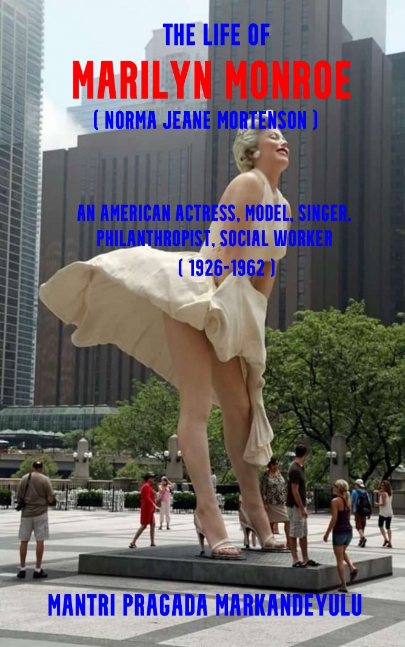
The Life of Ms. Marilyn Monroe
The Life of
Ms. Marilyn Monroe
(Actress, Philanthropist and Social Activist)
Ms. Marilyn Monroe, an Angel of the Moon, was born on June 1, 1926 (Los Angeles, California, United States). She died on August 4th, 1962 in Brentwood, Los Angeles, California, United States.
Marilyn Monroe’s Spouse was Arthur Miller (1956–1961),
Marilyn Monroe was married to Mr. James Dougherty (m. 1942–1946)
Marilyn Monroe married to Mr. Joe DiMaggio (m. 1954–1955).
Marilyn Monroe’s father is (Late) Mr. Charles Stanley Gifford and mother is (Late) Ms. Gladys Pearl Baker. Marilyn Monroe, original name Norma Jeane Mortenson, later called Norma Jeane Baker.
Marilyn Monroe’s Siblings are Berniece Baker Miracle, Robert Kermitt Baker
Ms. Marilyn Monroe was an American actress, model, singer Philanthropist and a Social Activist.
Norma Jeane Mortenson ((Marilyn Monroe) later took her mother’s name, Baker. Her mother was incessantly confined in an asylum, and Norma Jeane was reared by foster parents and, for some time, in an orphanage.
In 1942 she married a fellow worker in an aircraft factory, but they divorced soon after the 2nd World War. She became a popular photographer’s model and in 1946, signed a short-term contract with 20th Century-Fox, her screen and celluloid name as Marilyn Monroe. After a few brief appearances in movies made by the Fox and Columbia studios, Marilyn Monroe was again unemployed, and she returned to modelling. Her semi-nude photograph on a calendar brought her a role in the movie Scudda-Hoo! Scudda-Hay! (1948), followed by few other minor roles in other films.
In the year 1950, Marilyn Monroe played a small roll on the celluloid through a movie titled The Asphalt Jungle. This roll and her performance in this film attracted world-wide audience and hundreds of thousands of members became her staunch fans. That was the year Marilyn Monroe got a big break in the movies and slowly started becoming world-wide famous actress.
Marilyn Monroe was getting established in her own style in the movies and was popular in her own way. She was competing with other famous actresses in those days. Her little performances in the movies attracted many Film Production Houses like FOX and other giant film corporates production houses. (Please listen to the audio-video further)