

#AuthorLife

Riverside.fm USA-Author Interview of Dr. Mantri Pragada Markandeyulu,
Riverside.fm USA-Author Interview of Dr. Mantri Pragada Markandeyulu, Hyderabad (India) 8 July 2023

In the End
Coming up with a satisfying and impactful ending for a novel can be a daunting task for many writers. However, there are several strategies and techniques that can help you craft a strong and effective conclusion to your story.
Start with the beginning: Consider how you began your novel and think about how you can bring the story full circle. Your ending should provide a sense of resolution and closure that ties together the themes, characters, and plot points that you introduced at the beginning.
Identify the story's central conflict: Your ending should address the central conflict of the story and provide a resolution for the protagonist. This can involve the protagonist overcoming their flaws, achieving their goals, or learning a valuable lesson.
Consider your genre and audience: The type of novel you are writing and your target audience can influence the type of ending that will be most satisfying. For example, a romance novel might end with a happy ever after, while a mystery novel might end with the resolution of the crime.
Experiment with different endings: Don't be afraid to try out different endings and see how they feel. You might find that a different ending works better than what you initially planned.
Tie up loose ends: Make sure to address any loose ends or unresolved plot points in your ending. Readers should feel a sense of completion and understanding of the story.
Avoid cliches: Try to avoid predictable or cliched endings, as they can leave readers feeling unsatisfied. Instead, strive for an ending that is surprising, impactful, and unique to your story.
Seek feedback: Get feedback from beta readers or writing groups to see how your ending is received. This can help you identify any areas that may need improvement or clarification.
In summary, the best way to come up with an ending for a novel is to start with the beginning, address the central conflict, consider the genre and audience, experiment with different options, tie up loose ends, avoid cliches, and seek feedback. With these strategies in mind, you can create an ending that leaves a lasting impression on your readers.
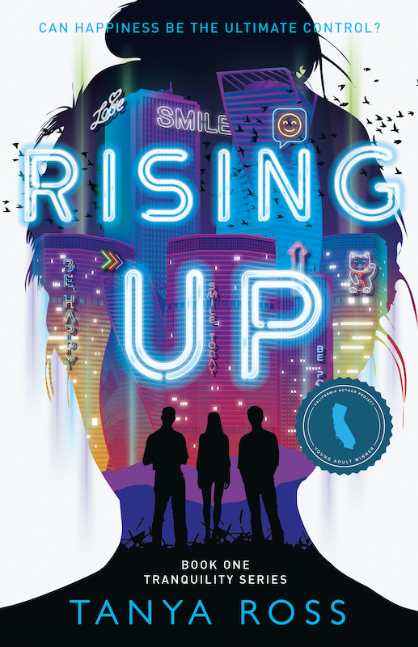
HOW THE X-FACTOR SPAWNED A DYSTOPIAN NOVEL
Have you ever dreamed or thought about what it would be like to live in a world where the number one priority is to be happy, joyful and peaceful? Welcome to Tranquility. A place where you let all of your fears go. However, how would you feel if you were forced to be happy? What if your every emotion was being monitored? This is also Tranquility.
“How did you come up with that idea for your series?” This is the most asked question when I present my author talk to groups of middle and high school kids. It is indeed a story in itself.
Thirty-two years ago I was like everyone else in the general population. I had no idea what Fragile X was. That all changed when my son, Jordan, was diagnosed with it at age two.
Fragile X syndrome (FXS) is a genetic disorder caused by changes in a gene that scientists label the FMR1 gene, which makes a protein called FMRP, necessary for brain development. People who have FXS do not make this protein.
It’s a devastating diagnosis. And believe it or not, it’s not that rare. The precise number of people born with FXS is not known, but studies estimate that about 1 in 7,000 males and about 1 in 11,000 females have been diagnosed with FXS. Although it is not an illness and not life-threatening, it is life changing for the entire family who has a child with this irregularity. Males who have FXS usually have some degree of cognitive disability that can range from mild to severe. In other words, I found out my child would never be normal. He would not grow up to be a doctor or a lawyer, or even hold down a low level job. At the age of three, he spoke almost no words and had failed many of his milestones. Early assessments were grim.
But that’s not the only problem with Fragile X individuals. One of the main characteristics is that they have almost no regulation of their emotions. Because of the absence of the FMR protein, the brain’s amygdala doesn't function properly. If you’re not familiar with that part of the brain, it can be summed up this way: “The amygdala is commonly thought to form the core of a neural system for processing fearful and threatening stimuli, including detection of threat and activation of appropriate fear-related behaviors in response to threatening or dangerous stimuli.” The key word there is “appropriate.” In FXS, the fear response is heightened, and this results in huge changes in mood and the inability to control stress effectively. Very small things can trigger aggression, sadness, frustration, anxiety, and a desire to self-isolate if the FXS person perceives a cause for alarm. Common, everyday experiences can be menacing to a Fragile X child and could set off a response where he becomes angry or agitated. Much like a toddler, if things don’t go exactly as he expects, he will react in a negative way.
As a family we have worked very hard to teach and encourage proper emotional responses from our son. Now Jordan is thirty-four. With years of behavior modification and pharmaceuticals, Jordan can navigate many more stressful situations adequately. And just like the negative responses, we see as much exaggeration in the positive as well. He is beyond loving, loyal, hard-working, and funny. Today he spends his time doing volunteer work and has a vocabulary that rivals mine. He has come such a long way and makes me very proud.
So, what does this have to do with my books and the futuristic city of Tranquility, featuring a sixteen-year-old girl named Ember, the center of the plot?
One hundred years from now, a domed city exists, a perfect town of safety, beauty, and cheer—no crime, no disasters, no disunity. The people are positive, kind, and loyal. The only requirement is agreeing to wear the Alt, an electronic wrist device, to measure emotional highs and lows. Based on Alt points, those who maintain cheerfulness will rise up in society to achieve one level after another. Extraordinary pleasures and privileges await for those who achieve, while Banishment to The Outside is a threat for those who resist Emotional Management.
Ember Vintana, a shy but warm and compassionate sixteen-year-old, is unlike anyone else in the Utopian city. She is an Empath, a person who can see auras and feel the emotions of other people, even at a distance due to a genetic mutation. Emotions of her own tangle with those of others, and the untimely, mysterious death of her mother complicates her happiness and the maintaining of her Status on Level Eight of Tranquility’s society. Her goal is to conquer her darkest feelings, keep her empathic ability a secret, and stay true to the expectations of the perfect society in which she lives.
Rising Up, Book One of the Tranquility Series, is indeed a story greatly based on emotional control, and it was certainly inspired by my struggles with Jordan. But there are more threats than those that Jordan faces for each one of us. We don’t have to have Fragile X Syndrome to worry about emotion. Feelings govern everything. And in the world in which we live today, where technology also already controls much of what we do or say, parallels run deep to those more intense issues that Rising Up and Facing Off explore. The highs and lows of our emotions, which make us human, can often be the very bane of our existence. And at what point who determines what is acceptable and what is not?
Tanya Ross draws on her career background of thirty-two years of teaching middle school students, where high emotion, peer pressure, and the latest social media platforms influence vulnerable lives.
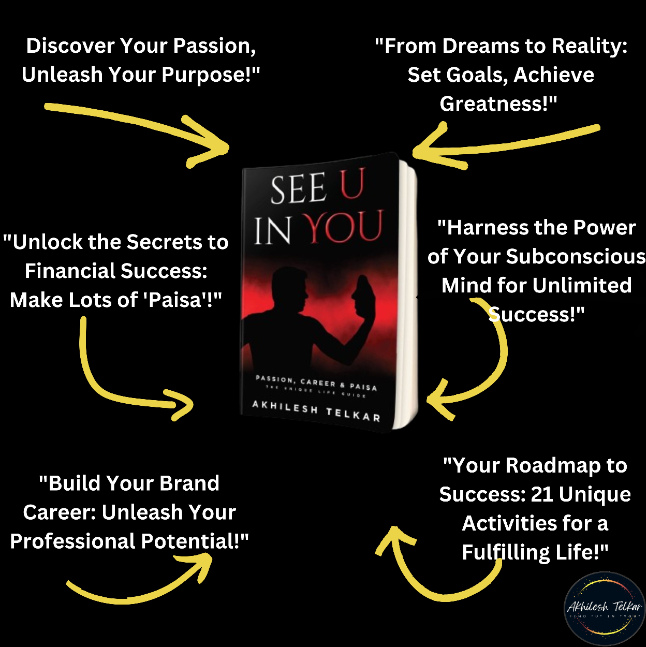
Unveiling Your Passion, Career, and Prosperity: Discover the Journey with See "U" in "YOU"
About Book :
The average human spends roughly 79 years, or 28835 days, on earth. So, there are an average of 692040 hours in a lifetime. Would you like to spend most of your time doing what you don't like? or do you want to follow your passion, build a brand career, and make lots of paisa for yourself? The choice is yours.
Every Human being on this earth came for some
Purpose; know your Calling, Passion, and Reason
for being here...
If you know early in your life, that is the first step to "success."
A palliative nurse who has counseled the dying in their last days has revealed the most common regrets we have at the end of our lives.
Top five regrets before we leaving this world are
- "I wish I'd had the courage to live a life true to myself, not the life others expected of me."
- "I wish I hadn't worked so hard."
- "I wish I'd had the courage to express my feelings."
- "I wish I had stayed in touch with my friends."
- "I wish that I had let myself be happier."
Bronnie Ware is an Australian nurse who spent several years working in palliative care, caring for patients in the last 12 weeks of their lives. She recorded their dying epiphanies.
After reading this, I started questioning
- What is one thing I can give to this world before i Go!..
- How can I transform people's lives!, so that I wont feel regret while i Go!
So my Idea behind creating this book is, I struggled with and had no clarity on when I started my career. I wanted to give the best of experience to those starters yet to enter into this real world.Still, I gained more clarity, more wisdom, more power to handle any situation in life when I found the formula for "Find "U" in "You." by following my passion.
My biggest realization is that I am mixing my “Passion and technical skill = Passiontech”
The Major Challenge is Seeing U in You, Who You are?, Finding Your Potential, Knowing your calling, Building your Character.
“Don't just become a Dreamer Become a Achiever” ~Akhilesh Telkar
Sometimes we lose our focus in life, for some they are sure they are on the right path in finding the answers of career.
The Powerful 4 W’s
1.Where to start?, 2.Which path to go?, 3.Why to do it? 4. Whom to contact?
By the end of this book, three things you will realize -
Passion - You who most of the time, ignoring
Career - Build the career you are looking for.
Paisa - Followed by Vitamin M. Who doesn't want this?
If you are holding this book that shows you are hungry to change, many will read the books, but only a few challenge themselves and take massive actions.
Stop being Common
Be the best version of Yourself
Change the old belief in you
Find “U” in “YOU”
Find the Passion in You
Become unstoppable and transform your career
Ultimately, fill the success bag with Paisa
See “U” in “YOU”
See "U" in "YOU" is a life guide with 21 practical step-by-step activities laid out to find "U" in "YOU" and success in seeing "U" in "YOU".
https://akhileshtelkar.co.in/seeuinyoubook
Warning: 50% of people who buy a self-help book won’t read till the end; what about you?